

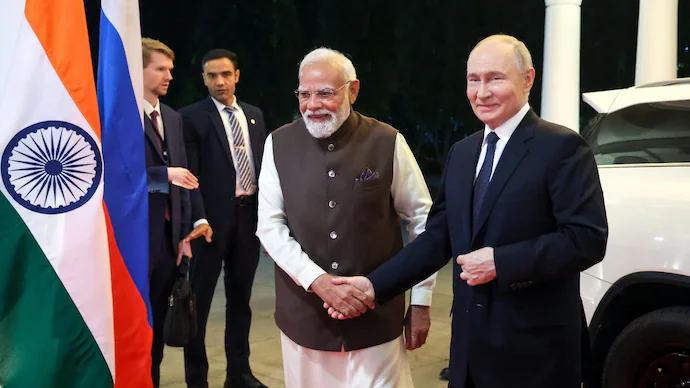
Russian President Vladimir Putin, during his visit to New Delhi, announced that Moscow is prepared to supply “uninterrupted shipments of fuel” to India, even as the country faces pressure from the United States over its continued purchase of Russian oil. Putin appeared with Prime Minister Narendra Modi following delegation-level talks at Hyderabad House.
The Russian leader questioned US criticism of India’s energy imports, pointing out that Washington still buys nuclear fuel from Russia. He argued that if the US can purchase Russian fuel, India should have equal rights and opportunities. President Donald Trump recently imposed an additional 25% tariff — raising total duties to 50% — on most Indian goods, linking the move to India’s energy trade with Russia. Delhi has rejected these claims as “unfair and unreasonable”.
India Repeats Stand on Peace in Ukraine
Modi reiterated that India is “not neutral” on the Ukraine conflict but stands firmly on the side of peace, supporting all initiatives aimed at a lasting settlement. Putin claimed Moscow was working toward a peaceful resolution but warned Ukraine must withdraw from the Donbas region “or Russia will seize it”.
The visit comes as the US simultaneously holds negotiations with both Russia and Ukraine in an attempt to broker a broader peace framework.
Major Nuclear Commitment: Kudankulam to Reach Full Capacity
Alongside the energy dialogue, Putin announced Russia’s strongest commitment yet to India’s nuclear sector. Moscow will help take the Kudankulam Nuclear Power Plant — India’s largest — to full 6,000 MW capacity.
- Two of the six reactors are already operational.
- Four reactors remain under construction.
- Russia’s state-run Rosatom has delivered its first batch of nuclear fuel for the third reactor, with a total of seven shipments planned.
Putin said the full-capacity operation of Kudankulam will make a “significant contribution” to India’s long-term energy security. He added that the two countries are also exploring cooperation on small modular reactors, floating nuclear plants, and non-energy nuclear applications, including medicine and agriculture.
Fuel, Trade and Mobility Agreements
The two nations also signed several documents covering agriculture, trade cooperation, minerals and civil nuclear expansion. Modi announced:
- Two new 30-day visa schemes for Russian tourists
- Opening of two new Indian consulates in Russia
- The launch of Russia Today (RT) in India
Putin highlighted Russia’s status as a reliable supplier of oil, gas, coal and nuclear materials, expressing confidence that India-Russia bilateral trade can rise from $60 billion to $100 billion.
Geopolitics and Defence
While no major defence deals were revealed, the leaders confirmed new agreements in shipbuilding, critical minerals, and nuclear investment. Their joint statement said the partnership is shifting toward joint research, technology development, and co-production of advanced defence platforms.
Both leaders emphasised deep coordination through BRICS, calling for a multipolar world order and “more just” global systems.
India Balances US Pressure
India — the world’s third-largest crude consumer — continues to rely on discounted Russian oil, though some Indian refiners have reduced imports to comply with US sanctions. Despite tensions and unresolved tariff disputes, India maintains that its energy decisions are driven by economic needs, not geopolitics.


